
The Village
Posted on October 23, 2014 Leave a Comment
I.
There was only a sliver of sunlight remaining in the middle courtyard – really just a sword of uneven brightness across my legs, outspread on the broken concrete. Too tired to get up, but knowing it would soon be dark, I let myself be distracted by the old woman who’d moved in last week to the apartment across from where I sat. She backed out of her doorway, a colorful headscarf dancing off her shoulders, and eyed me doubtfully, while roughly turning the key to lock the door. She pulled on the doorknob a second – then a third – time, to ensure it was really locked.
I looked away, but not before eyeing her doubtfully, then jumped to my feet. She was dark, wore all black – except for the headscarf – and her long skirt blew up over her ashy knees in a sudden late summer bluster. All of this I noted in the infinitesimal moment our glances coincided before we each broke away, back to our own worlds. Back to our own suspicion and judgment.
Wiping imaginary dust from my shorts to avoid an encounter with her, my back turned, I felt her lumber past me. She pushed a bent grocery cart from the Foodtown up the street, and her breathing was thick and deep.
“Deserter,” I heard her mutter.
I continued walking toward my front door, unfettered by her bizarre utterance and set in my refusal to garner any further attention from her. Crazy old woman.
“That old lady is nuts,“ Mama sighed as I skittered past her, up the few steps to our front stoop, then into the apartment. I felt my shallow breath and heart pounding as I sank into the sofa, kicking off my sneakers one by one, with a shiver.
II.
“I know you heard me, little girl,” she said, the next day, when we met up unexpectedly by the half-open side door, where the washing machines and dryers all hummed and thrummed simultaneously.
In fact, I hadn’t anticipated seeing her that day, since it was Sunday, after all, and she looked like the type who would be in church all day. All day, and well into the evening, long past when I’d be snug at my mama’s feet by the sofa as she watched television, poised to bolt into the kitchen at any moment. I knew quite a few crazy old ladies, and that’s where they mostly spent their Sundays – or at least I thought. Yet here she stood. And here I stood.
Pretending not to see her – as ridiculous as that was, since she was only a few inches away and directly in front of me – I turned on both heels. At the same time, the old woman grabbed the bottom edge of my t-shirt, and I stumbled forward, forced to twist myself back around.
“I said, I know you heard me, little girl,” she confronted me, finishing her sentence with a low grumble, like an “mmm-hmmm.”
“And I know you can speak,” she continued.
No, I could not speak. And I would not speak to her, even if I could. She was frightening, and I couldn’t imagine why she had singled me out in this way.
“A deserter. That’s what you are,” she accused me, letting my shirt go abruptly. I remained still, but silent. “I seen you with your friends.”
What was she talking about? I had no friends in the Village.
III.
We moved here last year after Daddy died, which was in March. Although it was only a few blocks from our old house – and so only a few blocks from almost all of my friends – I had spent the summer alone. One by one, I counted them as they fell away, some with carefully crafted excuses and some only with the silence of embarrassment poor people always seem to receive from those around them. Settling into the summer here, I quickly acknowledged I would neither be readily accepted by the Village kids, nor would I attempt to win them over.
Either way, I did not have any friends.
And I didn’t care.
IV.
A few days later, as I balanced along the curb, pretending to be a gymnast, I noticed the ambulance pulling out of the hospital driveway behind where we lived. Although it was common enough, something caused me to skip off the curb. I was drawn to the middle courtyard.
Then I saw the small crowd of people, hovering over the walkway. I saw her, too. She lay flat on her back, motionless. Her bent shopping cart was on its side, in the grass, a paper bag with fruit, opened boxes of rice, and a white paper wrapping with some kind of fish or meat spilling out of it rested nearby.
At that moment, I knew she was gone. For the next hour or so, I watched as she was taken away, fully covered, in the ambulance. And I waited to see if someone would pick up her scattered groceries.
But they did not.
V.
Months later, after the school year had started, I remembered.
It came back to me as a gift from the recesses of my memory, now that I had settled – lonely – into the routine of the second marking period. A blunt-edged, but largish, gift box containing one word fell forward into my thoughts.
Deserter.
There had been a day in winter, when I still had friends, that we roamed the park together. The ground was packed with gray snow, and the street winding through the park was covered in foul, blackened slush – icy in spots and altogether treacherous.
That’s when I had seen her.
The old woman pushed her bent cart through the perilous heaps of snow, unable to travel more than a few feet, before sitting on the half-visible, wet curb. She sank gently into the snow, and she eyed me doubtfully, asking “Help me, little girl, will you?”
I quickly turned around, following the other kids who were already jumping from one ice block to another in the semi-frozen brook which, in the spring, would be framed by brilliant pink cherry blossom trees. I imagined the ground blanketed in silky pink petals as my feet crunched in the snow, walking away.
In that moment, I had seen the great death, but I had turned away.
It was only now that I realized scars faded as flowers. And the Village was now my home.
“Thank you,” I whispered.
The Hair Tie
Posted on October 13, 2014 Leave a Comment
One –
If it had snapped – the way those cheaply-made hair ties usually do, in that weak spot where they are joined together – it would have rested as a thin, black ‘S’ in the cracked pavement. It didn’t, though. It slid out of her lanky, slippery hair, bounced off her tote bag, and landed gently in a crevice between a back tire and a faded white line demarcating her parking space. A white line that would be paved over and repainted a fresh, neon white by the next afternoon. Underneath which the hair tie would remain.
She ran her short fingers through her hair, tossed the tote bag onto the back seat, and blurted, “Shit.” Sitting in the driver’s seat, she reopened the car door, scanned the ground and her lap for the lost hair tie, then hastily fluffed her hair in the rearview mirror with a shrug. As she backed out of the spot, her tire rolled over the round hair tie, leaving a tattoo of road dust and flattening it further into the crevice.
She drove away.
Two –
The neon white faded to a dullish grey, speckled haphazardly with dots of tar and smears of grease, through which a long cleft narrowed, then suddenly closed. The hair tie, now with frayed – almost disjointed – ends, peeked up through the gap, surrounded by dead leaves and blackened snow, promptly melting in the unseasonably warm spring heat.
The little girl picked it up and absently stuffed it in her back pocket.
“What is that? Where did that come from?” her mother scolded later that afternoon as the little girl wrapped it twice, then three times, around her little finger. “That could have lice on it! Give me that,” the mother alarmed as she grabbed and flung the hair tie over the picnic table and back into the parking lot.
The little girl shrugged and continued eating her sandwich, not knowing or caring what lice were.
Three –
The crumbling pile of asphalt rubble lay quietly in the still of a weighty and windless air. Beneath that motionless top layer, powdered with the dust of destruction, the hair tie is nestled. With one last elastic fiber holding its rounded shape, it sinks easily into the widened crevice. Oblivious to ruin, it waits. It remains.
But there is no one to stumble upon it. No one to carefully pick it up, roll it back and forth in a winter-dry palm, and vaguely wonder how long it’s been hidden. It will wait a long time yet, while the atmosphere slowly thickens, and pushes it further underground, everything simultaneously collapsing into itself in a heap of coagulated, compact mass.
Meanwhile, there is no one left to care.
Is There Dodgeball in Heaven?
Posted on October 9, 2014 Leave a Comment
On Sunday mornings, my mother teaches a C.C.D. class (that’s Confraternity of Christian Doctrine, for all you non-Catholics; not Central City Dump, for anyone who may or may not have attended St. Mary’s C.C.D. anytime between 1977 and 1981) to a group of first graders. They’re a pretty tough crowd. They need a lot of tissues. They break at least five pencil tips an hour. They all talk at the same time, blurting out priceless one-liners like, “Is there dodgeball in heaven?” and “I think Jesus’ mother was MaryAnn,” as well as this gem: “Wouldn’t it be great if Jesus was really real?”
I am only a helper in this class. An enforcer, of sorts. I’m there to ensure everyone walks to and from the bathroom without incident. Quietly. To remind that seats are for sitting. To pass out replacement pencils. A lot.
“Wouldn’t it be great if Jesus was really real?”
Of course, the answer was that Jesus is real and is everywhere, all around us, all the time. I say I believe that, and I want to believe that; but I get why it doesn’t seem so to a first grader.
It doesn’t always seem so to me.
Spirituality is important to me, if not so much by-the-book religion. It’s also very personal to me. There are some days I truly feel a divine presence in my life, and some days not. I think that’s what faith is all about – a personal range of belief within which you constantly struggle and from which you continually grow. It doesn’t have to be Jesus for everyone. But to believe there is some higher purpose for our presence in this life, and something greater binding us together and guiding us, is probably a good way to recognize Jesus around us. Even first graders.
When I go to mass, I am usually upstairs with the choir, where we are busy flipping through music and focused on what and when we are next singing. Whispering to each other about whether or not we will need to sing three or four verses of a hymn doesn’t necessarily lend itself to spirituality. So I need the first graders for that. To remind me, while I pass out the sharpened pencils and tissues, that faith – while personal – is passed on collectively. From my mother to me. From the entire community to our children. And it’s important.
Without faith, we are hopeless. Hopeless. And I need to have hope there is no dodgeball in heaven.
Skylab
Posted on October 1, 2014 Leave a Comment

At this, the end of the world, I feel more English than Zadie Smith –
not because of white teeth,
but because there is no way to write the stories without
insult.
Surely there is recognition in every word,
written unravelling to rest closest to the truth,
otherwise clouded with nostalgia, imagined nuance.
The price you pay, then, for sensitive observation is
isolation.
A habit becomes the sick feeling
– split-second, stomach sinking –
when you think of your own failure to exist, with
intensity.
Or that of those around you.
You are thus compelled, and not dissuaded, to tell it all.
Looking up at the sky with pent-up anxiety for what might be, you dream
impossibility.
It will fall on your head
when you least expect it.
The First Tree
Posted on September 29, 2014 Leave a Comment
From in between the opened slats of the blinds on my kitchen windows, I can see it. Each autumn, it is the golden harbinger of the coming season of crisp air and darkened evenings. Muted laughter through closed windows as children walk home from school, jackets unzipped. Somnolent bees hovering over brilliant mums, preparing for winter. It’s the first tree to turn – a radiant yellow, then a gentle brown, its leaves finally resting in a wispy pile sloping down a nearby hill.
I want to hate this tree. In fact, I want to hate the fall altogether. In the last two years, I have grown to dread this previously most-welcomed change of season. When you lose someone, every season becomes littered with the debris of loss and saddled with all of its accompanying sadness. There is nothing which can’t be despised when thought of in the context of loss. Especially things you once loved.
Fall was – is? – one of those things. My son especially loved the fall, too. As a child with severe neurological impairment, causing an inability to regulate his body temperature, the cooler fall temperatures were just cool enough to allow him to be outside comfortably without sweating and overheating, but not so cold that we looked like bad parents for leaving a heavy jacket at home. The fall was “his” time of year – so we were sure to pack it with lots of outdoor activities. Apple picking. Family walks. Watching his younger brother play football. A Halloween and harvest abbondanza – all leading to an eventual Thanksgiving weekend to usher in that other magical season. The one where his eyes gleamed with awe at colored lights and animated decorations.
Because his body betrayed his ability to participate in even the most mundane pastimes, his enjoyment of the world around him was reliant upon gathering up the sights and smells of the season through his own senses, with help from us. A crunchy leaf across his cheek. A taste of mushy pumpkin pie. A roll in his wheelchair through an apple orchard. All of these produced a hearty smile.
Fall, then, which had certainly been my own favorite season before, continued to be so, since it garnered such happiness in my child. It was his spring. The time of year when he blossomed, despite the inherent decay implied by the calendar’s dwindling days. It was his time.
Until one dazzlingly bright and sunny fall morning when he didn’t wake up.
It’s hard to keep loving the fall – or anything – when you lose your child. It’s irritating to endure the litany of insignificance present in the everyday – and especially present in the everyday of a time of year you once loved. A time of year that, in those glimpses of healing moments, you desperately want to enjoy – for the sake of your surviving family and your surviving self. But one that, unfortunately, weighs down upon you like an albatross. Or the thick, gnarled trunk of a golden-leafed tree on the cusp of autumn when it rests on your heart.
And so begins the fall. The first tree being the portent of this personal season of dread, fraught with memories of despair and laden with sorrow.
Or can it be transformed once again into a time of promise and hope? Can it flourish once again as the season for discovery and delight it once was for my son?
It can. I saw the first tree this morning. And so I believe it can.
Rio Grande
Posted on September 3, 2014 2 Comments
Irreparably, autumn deposits itself onto the last days of summer,
ombre strands still flying
stubbornly, unevenly.
Inseparably.
Tinged with the imminence of next summer,
overwashed neon letters peel
and hang ungracefully,
yet refulgent,
from see-through tops.
Shorts, tighter now, look seat-worn,
even up against the distance of a cloudless,
color-blocked blue sky.
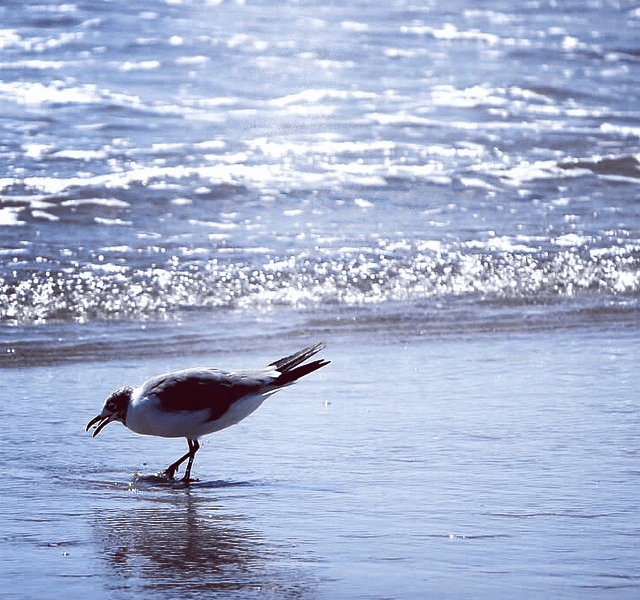
Two tiny girls walk hand-in-hand down Rio Grande,
free palms pressed with broken shells,
blonde tendrils knotted and darkened with sandy grit.
Their parents stumble in dusty drunkenness
behind them,
tobacco-stained fingers and teeth pitted in rage and defeat;
the unworthy are always gifted with such enormity.
Stories like these are grains of sand, a dime a dozen,
magnified by the coming cold.
One ear pressed to the boardwalk –
because the shells are empty now –
hammer-bent nails split our blotchy cheeks,
skin weathered and colored like the splintered boards themselves,
we listen
as it all bullies through –
the bicycle bells,
the thumping joggers,
the short order cooks shouting above each other in Greek,
and Luigi pounding his umbrella into the sand beneath the pier.
Above the low spray of the hose firmly speckling the air,
but never masking the smell of garbage underfoot,
or the beachcomber gliding by the water,
always leaving bits of wrappers and half-smoked cigarettes,
we listen.
Over the voices of those who say ‘awn’ for ‘on’
while pointing up at tired dotted black birds barely flying south,
the stingy economy of fate and empty karma unravel blamelessly,
while we rubberneck,
and listen.
Its genius comes in sleep and leaves when eyes are opened,
so we are unable to break our gaze at the ruthless intrusion of its truth into frivolity,
or summer
into fall.
Lioness
Posted on August 20, 2014 1 Comment
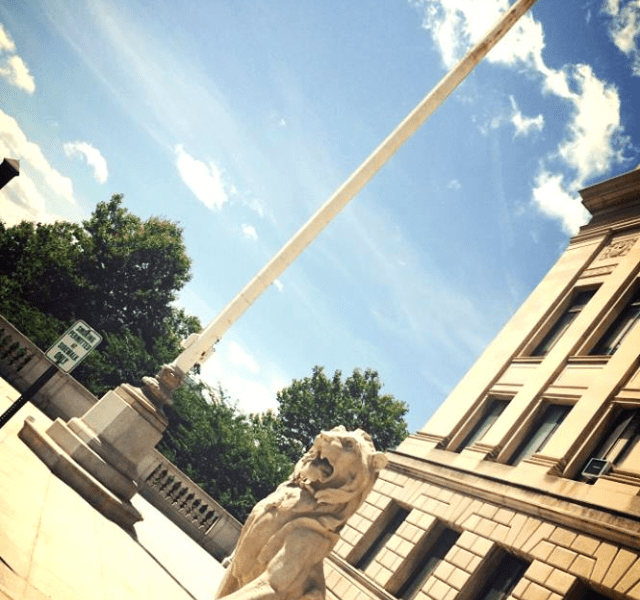
The prospect of jury duty is not as offensive to me as it is to many people. While it is, unquestionably, a nuisance to interrupt a busy work week with two uselessly hanging, disjointed days, translated into hesitantly accepted free time – since it is nearly impossible to conduct any meaningful work in a jury lounge, no matter how many devices one is able to connect to free Wi-Fi – it is our hard-won duty as citizens to serve. So you sit and read. Or you sit and stare at the other potential jurors. Or you get up and walk around to pass the time. Or you watch 1,000 ice bucket challenge videos.
I arrived at the courthouse reflecting on how it was the first time in at least fifteen years I was able to serve at all. Primary caregivers of children with disabilities, which I certainly had been, are often excused, as I had been excused before when I happened to be called. On this sunny Monday, though, my mind struggled with the reason why jury duty was no longer an impossibility for me. I no longer had someone relying on me for constant care because he had died. And while I have struggled with this reality before, and will probably struggle with it until the day I myself die, it doesn’t stop me from doing what I am required to do.
So I sat there, reading. Staring. Walking around. Watching ice bucket challenge videos. Even thinking that a bucket of ice dumped over my own head might serve as a decent diversion during the many hours of uninterrupted boredom I was passing. And so the first day of jury duty was one of solitude and forced quiet, punctuated by an unhurried lunchtime stroll through the surrounding streets of Newark on what was likely one of the most pleasant days of the summer.
Not so bad.
On the second day, settling into a cozy carrel where I expected I would be able to thoughtfully stare once again, I was instead called to a courtroom.
Damn.
While the experience had been reasonably accommodating thus far, it was about to change. If you’re curious as to what it might feel like to be “herded” somewhere, this is the place where it will happen for you. Like preschoolers we shuffled, an invisible rope leading us collectively to our destination, a musty courtroom inhabited by a musty judge. And so we sat, mustily, for hours on end as the tedious jury selection process played itself out in our midst.
A well-practiced observer by this time, I was quietly carrying out my work of casual staring behind a silvery, short-haired woman who reminded me of someone. She was familiar, but I couldn’t quite put my finger on why. After some time, she was called to the jury box by her name, which was also familiar. But the neurons in my brain aren’t very quick anymore, so I continued picking my fingernails with the rest of my cohorts. Until the moment I recognized her.
She was a nurse. A pediatric intensive care nurse. A nurse who had cared for my son weeks on end while he was intubated and suffered from aspiration pneumonia, recovered from surgery, and fought to stay alive. She was a nurse who had actively resuscitated him during at least two traumatic codes. She saved his life. She held my hand on September 11th when, sleep-starved and crouched in a crib holding a blue-lipped child, I thought it might be the end of the world. She was kind, competent, and her deeply-appreciated legacy to our family was probably only one of many thousands of patients and families who had crossed her path over a long career.
When it was time to break for lunch, overcome with excitement at this chance meeting after ten years, I approached her. As I explained to her who I was, the joy of recognition in her eyes was visible and genuine. And so we spent the next hour catching up – on bad news, on good news, on the places the intervening ten years had brought us. She remembered my son, our family. We had mattered to her. Not only as patients, but as people. As human beings. As fellow souls just trying to get through our lives, stoically fielding the unexpected curve balls thrown at us as best we could.
Now retired, she told me she often got together with some of the other nurses with whom she had worked, and sometimes my son would come up in conversation. They would remember how adorable he was, what a fighter he was, and how he beat the odds so many times. And how his mother was such a lioness.
A lioness?
There are many days I am beleaguered by feelings of guilt. What could have been done differently to prevent my child from an untimely death at only 11 years old? I rehash the last few days of his life and wonder incessantly, obsessively. I am beset by feelings of failure and inadequacy, which, as I have come to know, while heartrendingly constant, are normal. Expected. I feel so very many things.
But I never feel like a lioness.
How does the cub of such a fierce lioness die during her watch? Because the lioness, while vigilant and attentive, doesn’t control everything in the universe. She is an advocate – but not clairvoyant. Lots of people – lots of well-meaning and truly qualified people – have tried to convince me of this truth, but it only sunk in when it was revealed to me on that day, as a message from my son, himself.
As we spent our time talking, Penny, the nurse, told me how it was completely by chance she had wound up in that courtroom for jury duty. She had been scheduled to serve a few months prior and, for whatever reason, forgot to show up. This was her rescheduled date. In my soul, I believe the reason was so that she would have this hour to sit and talk with me. There is no one who will convince me that we were not meant to cross paths again after so long, or that it was just unforeseen providence or luck to have encountered her as I did.
No, it wasn’t a rescheduled date, but a significant gift of actual absolution, truly appreciated by me for the first time since my son’s death almost two years ago. It was David saying, “Mommy, you remember Penny, and how good and kind she was to me, to us. Listen to her. I’ve arranged for her to be there to let you know that everything wrong in the world isn’t your fault.”
So I will listen to him. If I will listen to no one else, I will listen to him.
Tikkun Olam
Posted on August 15, 2014 Leave a Comment
The world is sad, unjust,
tormented, broken –
but sunscrubbed hyperbole
will never mend it.
Isolated, singular refrains
of trumpeted exegesis
are inadequate, ineffectual
in our muted universe,
if the purpose is one of repair.
We must love the words we speak.
The world is joyful, righteous, untroubled, perfect –
but vitriol will never break it.
Its perfection still needs our help, though.
If the intention of our humanity
is to raze injustice,
we will fail alone.
We must speak the words together.
The world is forever –
but, resplendently endless in itself,
it cannot restore.
We must act on the words we speak,
the words we love,
together.
Tikkun olam.
End of Shift
Posted on August 7, 2014 Leave a Comment

Inflated insensitivity clocks out at 7:30,
hoisting its Michael Kors bags on twin, still-painless hips,
and smoothly bouncing past a faded blonde, head in her hands,
crouched on the curb and muttering prayers to her feet,
because death – even when anticipated – is vulgar and unexpected,
isn’t it?
They cross the driveway to the parking garage where,
at the end of every day,
parking spaces,
fought over just hours ago
with such indignity and indignance,
are now littered with misery
and missed opportunity.
I don’t have the fight in me to argue with their self-pleased conversation about people whose lives they know nothing.
It splinters the air, and my ears, like the crepitus in my own worn knees
and hips,
lingering and malingering ahead of me to my car.
Reaching the rooftop, the skyline’s hazy film blends blithely overhead
into an undercurrent of explosive cowardice, rude and ribald,
rife with the feeling of having looked up those same words
over and over, but never remembering their meaning.
Astoundingly, one stops to take a selfie –
appearing in context like Mussolini
in such a place
hanging upside down from a meat hook,
vaguely decayed and indecent.
Before selfies, there was the magical realm of impermanence called a mirror
(and good luck)
when moments like this were fast forgotten.
But now, gilded in gray as an evening dawn,
carefully filtered impudence is our window of opportunity
to see what’s left of our souls.
These wishes of the wild and wayward are all alike,
vacant faces of intoxication on a Saturday night subway train.
I can’t imagine why they want to remember such emptiness,
staring blankly and backing out of the last parking space,
away from the poorly disguised gibbet in my rearview mirror.
Still, I pity their inability to see through it yet,
end of shift.
Confidence is a Constant
Posted on June 25, 2014 2 Comments
When you’re feeling confident, you like to believe it’s for a reason, and not just a function of your own bias of self-preservation. The goal is to be self-assured in some kind of direct relationship with your actual worth and achievements, isn’t it? Anyone can think anything, you suppose, so when you wake up feeling like a million bucks, you sure do hope the feeling is somehow legitimate. You pat yourself on the back and go on about your day.
You got this.
And as you’re walking along, feeling oh-so-confident – probably even mentally high-fiving yourself – you notice the little things are just, well, so much better when you’re confident. Your dress fits better. Your hair doesn’t suck. Everything falls into place. Everything fits. Everything makes sense. Everything is awesome. It’s just like Legos, baby.
Then you get knifed in the heel by a sharp-edged, orphan Lego – one that has not fit or fallen into place in your confident reality. One that incites you to blurt out, “M!th@%u*^@!” to anyone with ears, as you realize the dress fits better only because you haven’t zipped the back up all the way. And you’ve walked around a good half day with your bra hanging out – possibly covered by your hair – but probably not, because, you know, you’re not Gisele Bundchen, and you could use a good three inches cut off the see-through ends of that hair. You know, the hair that doesn’t suck?
There goes the confidence. Damn it.
Never mind. You can still be confident. Confidence is subjective, yes, but not in the way you may have always believed. It shouldn’t be based on how you look, how you’re perceived by others, how you perceive yourself, or even so much what you’ve achieved. Those things are pretty subjective, and while you can, doubtless, bask in their glow, you shouldn’t in order to be confident. If your self-worth is based on outside influences – even your own opinions – it will always be flawed. Confidence should just be based on you. Not the subjective you, bursting with an emotional point-of-view and something to prove, but the YOU you. The one who has your own best interests at heart. The one who can flip her frayed hair (yes, like the L’Oreal commercial), zip up the now too-tight dress, and say, “Because I’m worth it.”
You pick the Lego out of your heel and pick your head up – confident. Confidence is subjective, but the subject is constant. You’ll always be you. Make your confidence a constant.
 A Girl by the Bridge
Recent Comments