
Hoax
Posted on August 19, 2020 1 Comment
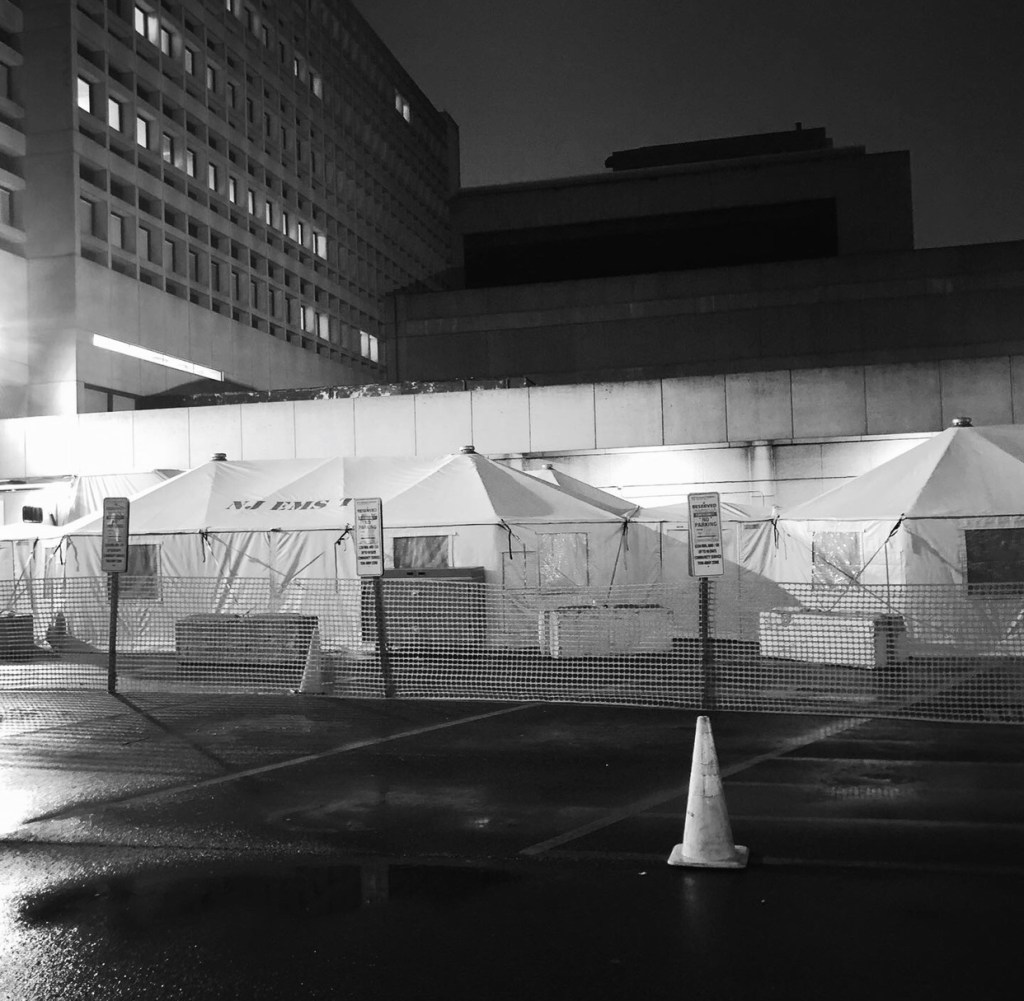
In the hoax tent across from me sat Dr. Patel
I think.
Hard to tell
with that mask,
but her eyes were familiar, from other days when
we wore no masks
and huddled together for rounds
and codes
and could read each others’ lips, not eyes
teeming with terror.
Like now.
When we each caught the other glancing,
Hey, I know you.
Will we die?
We both watched the bunny-suited man eagerly spraying
each empty chair with bleach,
not bothering to wipe,
so when that old woman stumbled backwards to sit,
then slowly got up when called,
the seat of her jeans had turned white.
And we both instinctively looked at our own pants,
now also white.
Didn’t we feel that wetness?
No.
We were only thinking of breathing.
The day before
and the day before that,
in the hoax hospital,
when I had felt a vague prickle in my throat,
I thought of allergies, shrugged and
continued caring for hoax patients
with blue lips and bounding chests like seesaws
and eyes full of terror not yet appreciated,
unable to think of breathing.
I can smell the bleach.
That’s good, right?
Nervous, muffled laugh conversation
awaiting the hoax swab and its hoax results
which will mean weeks of only this –
breathe
breathe
breathe
but at least I can think it.
Do it.
And so not die.
Now we laugh again, passing in the hallways,
Crinkled eyes above hoax
masks
masks
masks
We were kidding all along.
Able to breathe.
Only a hoax.
But I have not ever seen Dr. Patel again.
Twenty
Posted on February 26, 2019 Leave a Comment
At 7 a.m., in the nearly empty parking lot of a well-maintained office building – a building which, by the way, had a contract with Metropolitan Flower Exchange for regular placement and maintenance of seasonal plants, as well as a super named Joe, whose broken Italian-English often left us mystified – I sat and read the last chapters of American Pastoral, waiting to start my new job.
Monday, March 1, 1999.
Of course, I didn’t know anything then about the flowers, or Joe, or really anything about Bergen County. I might as well have been starting a new job on the far side of the moon, which this place certainly was to me. I had not even known that you could contract for people to come and take care of your flowers. Or your fish tank – which I later learned we had in our waiting area. And that it was cleaned using our lunch room sink (see: Elissa’s Reasons to Close the Lunch Room Door). In my neighborhood, we took care of our own flowers, fish, and whatever else we had going on.
It had taken me a considerable amount of courage to even apply for this new job. I was already on year thirteen where I was, comfortable and contented at age 28. On a whim, I applied for a position as a nurse paralegal at a medical malpractice law firm. It was what I wanted to do, combine my love of nursing and law and turn it into a career. I was hired on the spot, and three weeks later, I was beginning a new chapter.
I didn’t know that I would meet some of the most influential people in my life on that day, as well as in the years afterward. These people would be by my side during some of the best and darkest hours of my life. Through achievements, failures, joys, and sadness. Through just regular everyday kind of stuff. Work. Laughter. Personal growth. Boredom. Challenges. Arguments. Illness. Birth. Death. September 11th. Just about everything. Five days a week, I drove to that office, and it became my second home.
And those people became my second family. No, my family.
I never thought I would have twenty years of memories to reflect on. On the first day, I reviewed a hospital chart with the boss, a physician attorney. He asked me what ARDS was, and I whispered the answer. I was intimidated. I wanted to go back to my old job, where it was safe and where they knew me. Here, in the foreign land of Bergen County, no one knew if I was quiet or frightened or just dumb. Or all three. I had to prove I had a brain.
It was going to be hard work.
Over the years, though, I think I did prove I had (have?) a brain. Through countless changes, the one who gave me the chance to shine was the one I could barely whisper to on that first day. Now, he still commands my utmost respect, even if I don’t need to whisper anymore. To anyone. Ever. And that’s mostly because of the confidence I’ve acquired over all this time, thanks to the chance he gave me twenty years ago.
Here’s to twenty more. Thank you, Dr. Goldsmith.
Nevertheless, She Persisted
Posted on February 5, 2018 Leave a Comment
 Many years ago, there was a blonde nurse who was a member at the pool club in my town. She used to arrive in the late summer mornings to relax by her cabana before work. Around 2 p.m., she would change into her smart uniform in that cabana, like a superhero in a phone booth, and set off for her shift, arms glowing against the brilliant white of her capped sleeves. I watched her every summer afternoon as a teenager, envying her sleek, professional air, and wanted to someday be like her.
I was a kid on a raft trying to get a tan, instead getting splashed by an endless gaggle of fourth graders on the diving board.
She was a critical care nurse.
And so I, too, signed up to become a nurse.
My nursing career began much like the medical career of Doc McStuffins – wearing one of my father’s white shirts as a “lab coat” and my mother’s volunteer pins from St. Michael’s and Clara Maass Hospitals as my “badges,” tending to an array of toys with assorted ailments in my imaginary intensive care unit. I even crafted an IV pole from a portable aluminum clothes hanger, complete with a bottle of normal saline (otherwise known as water) connected to my “patients” with string. I wrote thoughtful, detailed notes on the care I was giving, which I hung on a battered clipboard. Most importantly, though, was my homemade identification tag, on which I had written in thick, official, black marker and safety-pinned to my shirt:
LISA, R.N.
Later on, I actually went to college and received a real nursing license.
But I didn’t have the confidence to be a critical care nurse. I practiced in a bunch of other areas which, while satisfying and challenging in their own ways, were not the elusive Holy Grail of nursing practice I had always envisioned critical care nursing to be. In my mind, I believed myself to be unsuited, underqualified, and unprepared for such a role. A role to which, while secretly coveted, I would never admit to aspiring aloud.
Until one snowy day in January of last year.
On that day, I was offered a job as a critical care nurse in an urban teaching hospital. Shocked, I immediately accepted before it was retracted. Which I was sure it would be. (It wasn’t). I told practically no one until I got in my car to drive to my first day of work, fearing it would somehow not be real.
It was real. It is real. And I am now approaching my one year anniversary.
Although I would like to say it was a smooth and simple journey to transition into intensive care nursing, I would be lying. It was not. On my first day on the unit, I was very close to running away screaming (not hyperbole). I had to convince myself – and so did quite a few others – to return each day. To keep trying. To be an old dog learning new tricks – because, yes, these were all extremely new tricks for me. Skills I wasn’t sure I could ever master at this point in my life.
Nevertheless, I persisted. I persist.
I show up. I learn something new every shift. From my awesome coworkers and educators – the smartest and toughest group of nurses I know. From my manager – the smartest and toughest of the smartest and toughest group of nurses know. From the attendings, fellows, residents, and respiratory therapists. From the patients. Mostly, from the patients – not an array of toys attached to pretend IV fluids, but really, really sick people. Sick people who arrive on our unit from all different corners of the socioeconomic spectrum, and who receive an equal level of superior care and respect.
Once upon a time, I wanted to be that blonde, tan critical care nurse, gliding into her evening shifts like an afterthought. Now I know she was a myth. I have no way of knowing what her work life was actually like; however, I do know what mine is like. My scrubs are full of unidentified stains when the lights come on at 7 a.m. My clogs are sticky. My hair is messy. My eyes are bloodshot. My confidence is sometimes non-existent.
Nevertheless, I persist. As we all should. In whatever it is we do.
A Christmas Story
Posted on December 27, 2017 Leave a Comment
While Black Bart was getting his
you were getting yours –
sodium bicarb
calcium gluconate
D50
– not with a Red Ryder BB gun,
but a triple lumen CVC,
‘as beautiful,
as coolly deadly-looking a piece of weaponry as I’d ever laid eyes on.’
Bullets to save, not slay –
Mannitol
3% sodium
Zosyn.
Your family said it was your favorite movie –
the part when Flick’s tongue got stuck –
and so I looked at your tongue
leaden and dry and swollen
stuck
stuck
stuck
to the ET tube,
and I bathed it with Peridex
because you could not cry like Flick
or wave your arms
so Miss Shields could see from the window
your singular misery.
I could see it in front of me.
On Christmas morning,
you would not shoot your eye out –
your eyes would no longer open.
And that was the greatest gift you received,
or would ever receive –
despite my best efforts to keep it from you.
A Nurse’s Introduction
Posted on July 25, 2017 1 Comment

There are telltale signs we will meet again –
the crumbling dryness of your feet,
the purplish opalescence of your shins,
the belly –
taut with distension,
and the hint of yellow in your eyes,
from which, even as you’re joking now,
a few feet away from me in the grocery store,
jovial crinkles surrounding them
meld softly into rivers
of tiny pink lines
that dive off the tips of your nose
and are then carried away on a phlegmy laugh.
It is a certainty.
We will meet again.
Not at barbecues
or weddings
will we be introduced, no;
but while I describe the beauty of the sunset
as it rushes into the grimy windows of your corner room,
bathing you in a quick wash of final light.
And as I pull you up,
your family will tell me your story,
and I will nod,
and smile,
and secretly cry,
knowing I am too late to know how fun you were,
or meticulous,
or vain.
Or really anything at all about you –
except that you will die.
We will meet again in the ungodly hours of the morning,
when your husband no longer hears your breathing,
or when your neighbors haven’t seen you
for that one brief moment you empty the mailbox
each and every day.
We will meet again amidst open boxes of epinephrine
and puddles of normal saline underfoot,
multi-colored caps hastily popped off by trembling thumbs
hoping to keep you alive –
and maybe succeeding,
for, after all, how do we measure success?
And what is certainty?
Certainly, not this.
But it’s a pleasure to meet you.
Waiting for the Great Pumpkin
Posted on October 12, 2016 Leave a Comment
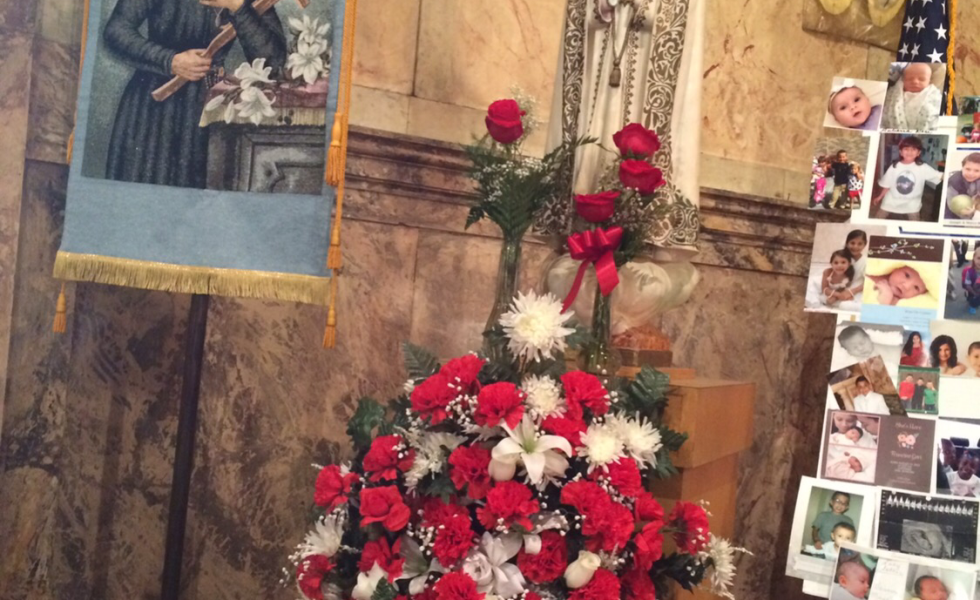
For those of you unfamiliar with Roman Catholic idiosyncracies, it is customary for the faithful – and some of the unfaithful, too – to pray to the many saints for intercession with God. In any and every situation, for every need, there is a saint to whom one might turn for help. Some sixteen years ago, I turned to St. Gerard Majella, whose feast day is October 16th. If you’re from the Newark, New Jersey area, or you’re Italian-American – or if you happen to be named Gerard – you may recognize St. Gerard’s importance.
He is the patron saint of mothers. Expectant mothers. Women who would like to be mothers – usually a despairing bunch when unfulfilled in purpose. I found myself to be among them once. Married for a number of years, wishing to open our hearts to a child. Except it didn’t happen quite that easily. So I turned to St. Gerard. Certainly, his intercession – along with the obvious – would prove obliging. Relics and prayer cards and medals and masses. These are the things devotion is made of. Devotion which, if precisely carried out, would result in the gift of a baby. For those of you who aren’t so religious, it is sort of like waiting for the Great Pumpkin to rise out of the sincerest of pumpkin patches. I’m sorry if that’s irreverent, but it’s the only thing which comes to mind. (After all, this is the time of year to write to the Great Pumpkin.)
My sincerity was unquestionable. My devotion unassailable. And so the Great Pumpkin – I mean, St. Gerard – offered his gracious intercession, and I was granted my pregnancy. Regardless of who had intervened on my behalf, this child was a gift from God. We were grateful beyond measure, and I was thankful to St. Gerard. Of course I was. We’re always content when we receive exactly what we wanted. Who was I to question the reality of St. Gerard’s influence in divine affairs?
After the birth of my older son, I thanked St. Gerard heartily. When things didn’t go very well for him, and he was diagnosed with cerebral palsy, I still thanked him. He was our blessing. I thanked St. Gerard again when I was given the gift of another beautiful baby boy a few years later.
This was easy, right? Babies? Sure, just ask St. Gerard. He’s dropping them from heaven like flies, forget about it. Or, should I say, fuhgeddaboudit? Because he’s especially looking out for us Italian girls, no?
Then, one October 16th, I awoke to find my son dead.
I had forgotten it was St. Gerard’s feast day. Gratitude is funny like that. Often, when something is given, we forget to be thankful over time. It was the same for me and St. Gerard. As my young children were no longer babies, he had fallen off my radar. So had religion. The forgetting to be thankful morphed into anger for my older son’s multitude of medical problems.
Thanks a lot, St. Gerard. You, too, God. Thanks for making my kid suffer like this. My family. It’s amazing how self-centered we can be. Always looking to blame.
That’s how St. Gerard eventually came to occupy the number one spot on my shit list.
He stayed there for a year.
Then Tyler was born, a year later, on October 16th. Tyler is the son of one of our dearest friends. A friend who had cared for our children, who loved them, whose wedding they were part of, and whom we considered family. She, too, had traveled a long road in order to become a mother. Of course, although thrilled for her and her husband, I couldn’t help but secretly feel St. Gerard’s sharp medal resentfully digging into my back. Did it have to be October 16th?
Yes. Yes, it did. And now I am appreciative.
A few months ago, our friend actually apologized to us for giving birth on that day. Apologized. As though she’d had any control over it. She did not. I did not. St. Gerard did not. It doesn’t work that way. Magical thinking is just that – magical thinking. I don’t need to be angry with St. Gerard anymore. I can go back to enjoying zeppoles at his feast every year at St. Lucy’s in Newark, the national shrine of St. Gerard and where Tyler’s christening was celebrated. It isn’t that I no longer acknowledge the sanctity of saints or the importance of prayer – it’s that I understand they possess no magical powers. What happens, happens. Our faith is what gets us through it. Not magical incantations, enchanted relics, or mysterious acts. Just faith. And love. (And possibly a little synchronicity, brought to you from beyond – St. Gerard, maybe?)
I remain faithful that there is a purpose in all things, good and bad. In that way, my pumpkin patch is the sincerest of them all.
No Pity for Princesses
Posted on October 7, 2016 Leave a Comment

Synchronicity. Meaningful coincidences. There are no accidents. Everything happens for a reason. There is a bigger plan.
We tell ourselves the events occurring in our lives are connected by meaning. Maybe they are; maybe they aren’t. As I’ve said before, I prefer to believe they are. Things make a bit more sense that way. Not much. Only a bit.
But I’ll take it.
While caring for a seriously ill child, a song spontaneously played on my iPhone, randomly selected by iTunes as a suitable children’s song. Thanks to technology, we can easily stream comforting music. Music, to serve as a pleasant backdrop in a room full of loud monitors, amidst the drone of an oxygen concentrator and the intermittent blasts of suctioning equipment. To drown out those misplaced medical noises in a child’s bedroom, otherwise full of lovingly placed stuffed toys and princess paraphernalia. Why should a pre-schooler have to listen to that, rather than dreamy lullaby versions of Twinkle, Twinkle, Little Star and Chopin’s Prelude 20 in C Minor, while drifting into another realm where – I am certain – she is reigning as the princess she is, breathing and moving easily? Playing. Laughing. Smiling. Living.
Unfortunately, her mother – a lovely young woman herself – knows that her daughter will never grow into the lovely young woman she was meant to become one day. Just as my own child, David, did not grow into the lovely young man he should now be. In that other realm – where genetics and oxygen are meaningless, and princesses don’t suffer – she will. She has. But here, in this realm – our unfair, inequitable, unjust dominion of indiscriminately colliding atoms – she has been dealt the worst cards of all from an even worse deck.
Or has she?
She doesn’t need pity. There is dignity and purpose and importance in her existence. We are not all here on earth for the same reason, are we? Your job here is different than mine. Different than hers. Different than that of every single other person who’s ever lived.
Her job is to be a princess. And princesses need no pity. Princesses bestow gifts of charity and assistance upon their subjects. Sometimes, their subjects are their nurses, and the gifts come in the form of an angelic child, dozing contentedly and breathing easily in her own bed after a particularly trying day. In her own house, with her family who love her beyond all measure. While her mother kisses her and tells me her daughter will bring messages to those who’ve already left this realm, this song plays by chance – and I remember what I already know. There is no chance in life, but there is charity. There are angels on earth, and some of them are princesses.
Only a boy named David
Only a little sling
Only a boy named David
But he could pray and sing
Only a boy named David
Only a rippling brook
Only a boy named David
But five little stones he took.
And one little stone went in the sling
And the sling went round and round
And one little stone went in the sling
And the sling went round and round
And round and round
And round and round
And round and round and round
And one little prayer went up to God
And the giant came tumbling down.
I never in my life heard that song before yesterday.
Thank you, Princess.
Leap Day
Posted on February 29, 2016 Leave a Comment

Does everyone carry all of their memories around with them, like an airport teeming with stranded passengers during an unexpected blizzard on the night before Thanksgiving?
Look, there’s thirteen year-old me, balancing The Heart is a Lonely Hunter on her knee, glancing up only to roll her eyes at 1977 Wonder Woman, about to board her invisible plane, blizzard be damned. But not before breezing past Mrs. Hoffman, a gnomish neighbor on her cross-country skis, hands on hips, (silently) judging the bright blue hot pants as they swish by her.
A cast of thousands not-so-patiently awaits a flight to the forefront of recollection, sparked by any of a million prompts – innocuous, inane, insane – at any given moment.
Sometimes, they are my reality. And it’s just fine with me. I am pleased to ponder minutiae. Whether my second grade book bag had an elephant with its trunk pointing up or down. (It seems my memory shouldn’t fail me on this one, what with the elephant and all.) Or if Ryan’s Hope came on at twelve or twelve-thirty.
I would rather spend a month with them than a minute with the Kardashians. Or watching the Oscars.
They are mostly a wise bunch, this cast of thousands. Even if they are stuck in an airport.
Today is supposed to be an “extra” day. Of course, that is fiction – confirmed by 1985 mom, who also told me my overdue library books are, probably, still overdue. Ok, definitely. Definitely overdue. (The Heart is a Lonely Hunter: due February 29, 1984)
Today is not an extra day. There are no extra days. There are as many days as there are – no more, no less. Leaping – on a calendar – is meaningless, except for the bookkeeping aspect of time. It makes no difference if today is February 29th or March 1st. If you did nothing yesterday, you’ll probably do nothing today, too. (I think that’s 2010 Mark Zuckerberg talking…)
Leaping isn’t for days, or years; it’s for you. There’s an airport full of marooned travelers dying to make their flights who just reminded me.
A Wrinkle in Time
Posted on February 22, 2016 3 Comments

I used to be ashamed of the wrinkles on my face. Especially the big, long one right across the middle of my forehead. This deep groove, my own river of embedded worries dating as far back as first grade, has been a part of me for almost as long. A child with an ever present look of puzzlement results in – you guessed it – an adult forehead in a permanent state of furrowed ruin. Makeup pronounces it. Harsh light bounces from its depths. Vainly, I often catch myself trying to pull this wrinkle apart with my thumb and forefinger, spreading and pressing the skin forcefully.
But it’s not going anywhere. And anyway that just makes my skin break out. (You know, touching the skin on your face is a no-no, right? Will I ever learn?) I trace it with my fingernail, rocking it back and forth at its deepest millimeter, right at the center, and it almost feels as though it’s part of my skull.
Could I have been so worried all my life, to cause an actual groove in my skull? I ask myself, brow crinkled. Damn it. Stop that!
Too late.
I guess the wrinkles do descend to my skull, after all. Maybe that’s where they started. From the inside out. Where all worries begin and end.
Someone around my age told me she believes I look older than she does because I have children and she doesn’t. Perhaps. It could just be genetics. Or it could be that I sit in a beach chair without a hat, refusing to wear sunglasses or drink water.
Or that I’ve fallen to my knees in a hospital hallway more than once, watching helplessly as my child was resuscitated through glass doors I wasn’t allowed to enter.
Or that I’ve attempted to resuscitate him myself, finding his lips blue and forehead cold one autumn morning when I tried to awaken him. And failed.
Perhaps these events – and countless more, both forgotten and unforgotten – have woven together across my face to form a distinctive pattern of lines and creases, the remainders of a lifetime of imperfections, efforts, concerns, sorrow and – most importantly – love. So be it. I’m not ashamed anymore.
I saw someone fretting over some (imaginary) wrinkles in a public restroom the other day. I wanted to tell her she was beautiful, even with the wrinkles. But I guess she’s just not there yet. I walked past her as she scrutinized her face, an inch away from the mirror. Furrowing her brow. I wished for her to one day appreciate all that has made her who she is – both good and bad – right down to the lines on her face. Especially to appreciate those.
We are fortunate to have gotten here; it is a gift. And we are beautiful, too – because of the wrinkles, not despite them.
“People are more than just the way they look.” – Madeleine L’Engle
Charlie’s Angels
Posted on February 5, 2016 Leave a Comment
The bridge actually had an official name. Lucy? Commissioner Lucy? It didn’t matter. We didn’t know who he was. What we saw was the dripped, spray-painted white
KHOMEINI SUCKS!
right there in the middle of the worn pavement, starting to now wear away itself. It was a closed bridge. Run down. Unable to withstand the weight of anything more than some kids and their bikes, it decayed with disuse. It was our tree house above the train tracks. A clubhouse. A line of demarcation separating us from the kids who lived on the other side. The neighborhood demilitarized zone.
And we were the appointed soldiers of this 38th parallel.
With our legs inserted through rusted sections of load-deficient railing, we swung them back and forth, above meandering freight trains whose engineers waved at us graciously from below. They were just too slow to fear. And we feared nothing then anyway. Maybe the trains were full of toxic chemicals on their way to be laden into the ground a mile or so away at Roche. Maybe they were full of banshees keening their way northward to frighten lesser children. Or bound with clay artifacts lifted from where they had been carefully placed by Lenape families. Holding our tub of iced tea mix, we licked our fingers, dipped them in, and thoughtfully absorbed the sugary, caffeine powder which, once wet, clumped sweetly on our tongues.
“Meet me by the Khomeini sucks,” we’d say – indirectly vulgar, but threatening enough to render it aloud. A starting point. An ending spot. A moment to rest in between a taxing game of hide and seek and a sultry afternoon of Charlie’s Angels at Yolanda’s house. A place to discuss who would be Kelly. Or Sabrina. It was so important to sort these details out ahead of time, before you were pointing your finger-shaped gun into the bushes, stuck being Sabrina. Again.
“Come out with your hands up.”
Those days, hostages were grainy images of the somber blindfolded. Khomeinis were posters of bearded men, bobbing up and down in crowds of self-flagellating foreigners while we ate our Prince spaghetti dinners. Or abandoned bridges, where children were left to the devices of their imaginations, fueled by light traffic and the heavy engineering delays of small town politics.
When the cars fly up Nutley Avenue now – even my car – over the spot where Khomeini once sucked, it is poignant. I see three girls, legs dangling without fear, staring down the headlight of an approaching locomotive. About to grow up.
 A Girl by the Bridge
Recent Comments